Executive coaching: what healthcare leaders should know
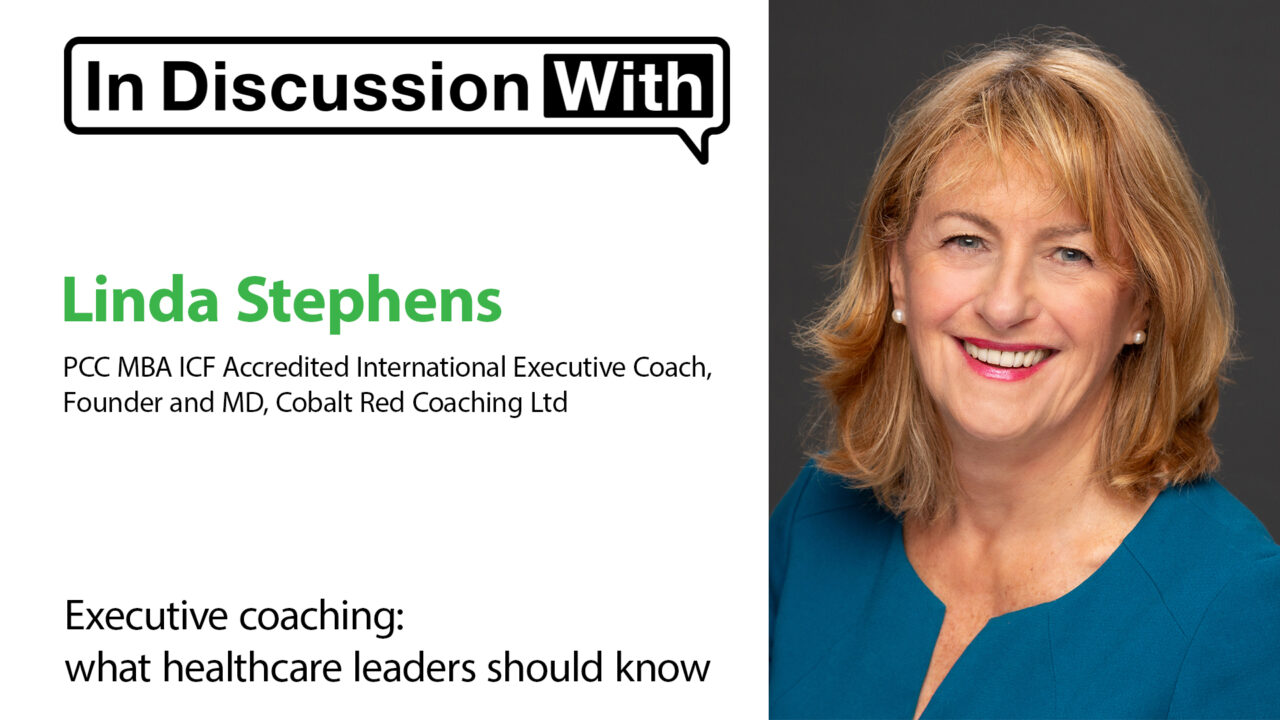
Executive coaching is often confused with mentoring or dismissed as a luxury for people who should “already know it all”. Linda Stephens, an international executive coach and founder of Cobalt Red, argues otherwise. In this interview she describes her journey from hospital pharmacy and the pharmaceutical industry into coaching chief executives and senior leaders, and explains why even the most senior people need somewhere to think out loud.
A career built on transferable skills
Ms Stephens stared her career as a hospital pharmacist, rising to Chief Pharmacist at Leicester General Hospital before becoming clinical director of support services, covering pharmacy, physiotherapy and sterile services, ten heads of department, with a £30 million budget and 300 staff. She moved to GSK where she became a global clinical director in the respiratory franchise. She later trained as a coach through an internal scheme alongside her day job. When she was made redundant in 2019, moving into full-time coaching “wasn’t a big leap”. She founded Cobalt Red that year and rapidly built an international client base spanning the US, Europe, Africa and Asia.
The provocation behind Cobalt Red
The company’s name references the Stroop effect, in which the word for one colour is printed in the ink of another, creating “cognitive interference” and forcing the brain to work harder. Ms Stephens uses “cobalt” printed in red and “red” printed in blue for the same effect, reflecting her coaching philosophy: challenging assumptions. “We all make assumptions. We all use stereotypes because it’s an easy way of getting around things,” she says. Her guiding principle is “never assume, ask and listen”. Discomfort, in this context, is a good sign: “If you feel slightly uneasy about it, change is happening. When change happens, that’s the magic.”
What makes a good leader?
Leadership, Ms Stephens argues, can be developed rather than simply being innate. Command-and-control management no longer works, since staff will quietly leave. Instead, effective leaders communicate well, listen actively, make thoughtful decisions, and combine emotional intelligence and resilience with the ability to see the bigger picture while still managing individuals on their own terms.
Courage, presence and the loneliness at the top
“Courage is not the absence of fear,” Ms Stephens says; it is acknowledging hesitancy about a difficult task and approaching it expecting a positive outcome while taking practical steps to reduce what might go wrong. She also distinguishes “being present” – simply being in the room – from “having a presence”, where body language, tone and timing of inputs build trust and respect. Coaching benefits anyone who has people reporting to them, but is especially valuable for chief executives, who typically have no peers within their own organisation. “It’s a very lonely position,” she notes, and many clients use coaching sessions purely as a sounding board.
Coaching for good: the African Leadership Academy
Ms Stephens dedicates around a fifth of her work to pro bono coaching. She started in 2019 after hearing a webinar talk by the chairman of the African Leadership Academy (ALA), a Johannesburg-based organisation that selects some of the continent’s most able young people. She now coaches ALA alumni, offering four free sessions each. She describes the work as “both challenging and rewarding”. Many of her clients have been black African women who face considerable pressures, from supporting extended families financially to navigating workplace misogyny. To date, she has worked with about 60 people through this scheme.
Finding a good coach
When looking for a coach, Ms Stephens recommends starting on LinkedIn, arranging a discovery call, and checking credentials such as accreditation with the International Coaching Federation, since anyone can call themselves a coach. A good coach never gives advice: “I’m not you. I’m not in your situation, and you’ve got plenty of friends who can do that for you anyway”, she says. It is also important to decide whether coaching or mentoring is required. Mentoring, Ms Stephens explains, suits people earlier in their careers who need someone else’s expertise and network. Coaching is different: it is “a meeting of equals”, where the client is the expert in their own business and the coach is the expert in coaching.
Coaching as a career
Ms Stephens recommends coaching as a career, but believes it works best for those who already have direct experience of business and difficult stakeholders, which builds authenticity and empathy. Her own path, from hospital pharmacy through industry leadership to coaching, illustrates how far a pharmacy qualification can travel: the skills learned at the patient interface, listening, questioning and building trust, transfer well beyond the dispensary.
About Linda Stephens
Linda Stephens is an experienced International Coaching Federation (ICF) -accredited coach. She is the founder and Managing Director of Cobalt Red which specialises in executive leadership coaching.