No cross-contamination found in automated repackaging of oral liquids
GERPAC Congress 2026 highlights
An automated system for repackaging oral liquid medicines into unit-dose cups (ADP-20L, NOODDIS) showed no cross-contamination between products, even under worst-case filling conditions, according to Yara Habib (University of Lille and CHU Lille).
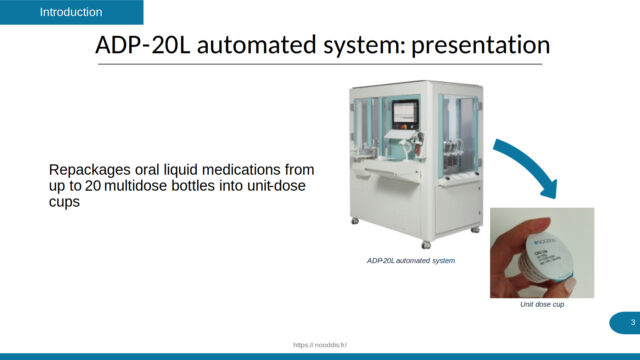
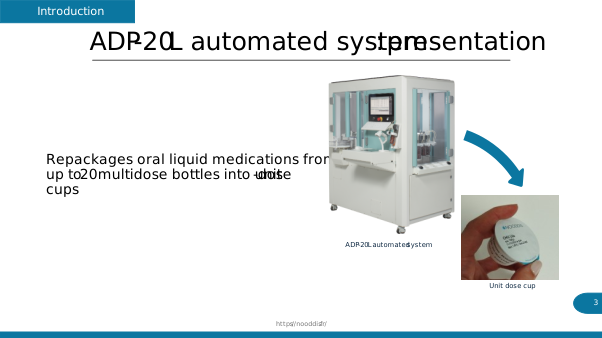
The ADP-20L repackages oral liquid medicines from up to 20 multidose bottles into unit-dose cups. Each medicine has its own dosing unit, consisting of the bottle, a pump, tubing and needle. A rotating carousel holds the bottles and a moving platform holds the cups. The researchers set out to assess the risk of cross contamination when different medicines were repackaged at the same time. The most likely potential source of contamination was thought to be splashes from one cup into an adjacent cup during filling.
Three test liquids were chosen to represent different types of oral liquid medicines. Water for injections (WFI) represented aqueous formulations, 70% glucose (G70) represented viscous formulations, and WFI/polysorbate 80 (80%/20%) represented foaming formulations. For each test liquid, the machine alternately filled a cup containing the test liquid with 2% fluorescein and a cup containing the test liquid alone. The two bottles were placed opposite each other on the carousel, so it rotated between every fill. Ten cups of each type were prepared per test liquid. Filling conditions were deliberately set to maximise the chance of splashing: the largest needle (14 G), the maximum cup volume (25 mL) and non-optimised filling parameters. Two operators inspected for splashes with the naked eye and under UV light. The 30 cups containing test liquids only were analysed for fluorescein by HPLC with fluorescence detection (limit of detection 0.015 ng/mL).
Filling with WFI and WFI/polysorbate 80 produced significant splashing, with 10–15 droplets around each cup. The droplets reached the platform around the filling position and the area beneath it. G70 produced at most one droplet per cup, because its higher viscosity limited droplet formation. Rotation of the carousel did not cause any drips. Despite the extensive splashing with the aqueous test liquids, no fluorescein was detected in any of the test liquid-only cups.
The authors concluded that despite the splashes observed under test conditions, the design of the ADP-20L, with sufficient spacing between cup positions, prevents cross-contamination between cups. The manufacturer has now introduced further design modifications to minimise the risk of cross contamination. In addition, work is under way to develop and validate an effective surface cleaning protocol.
The study was carried out as part of an industrial PhD fellowship (Cifre) with NOODDIS and the University of Lille.
Habib Y, Bouchfaa M, Négrier L et al. Assessment of the contamination risk in an automated system for the repackaging of oral liquid medications (ADP-20L). Short communication. GERPAC Congress 2026


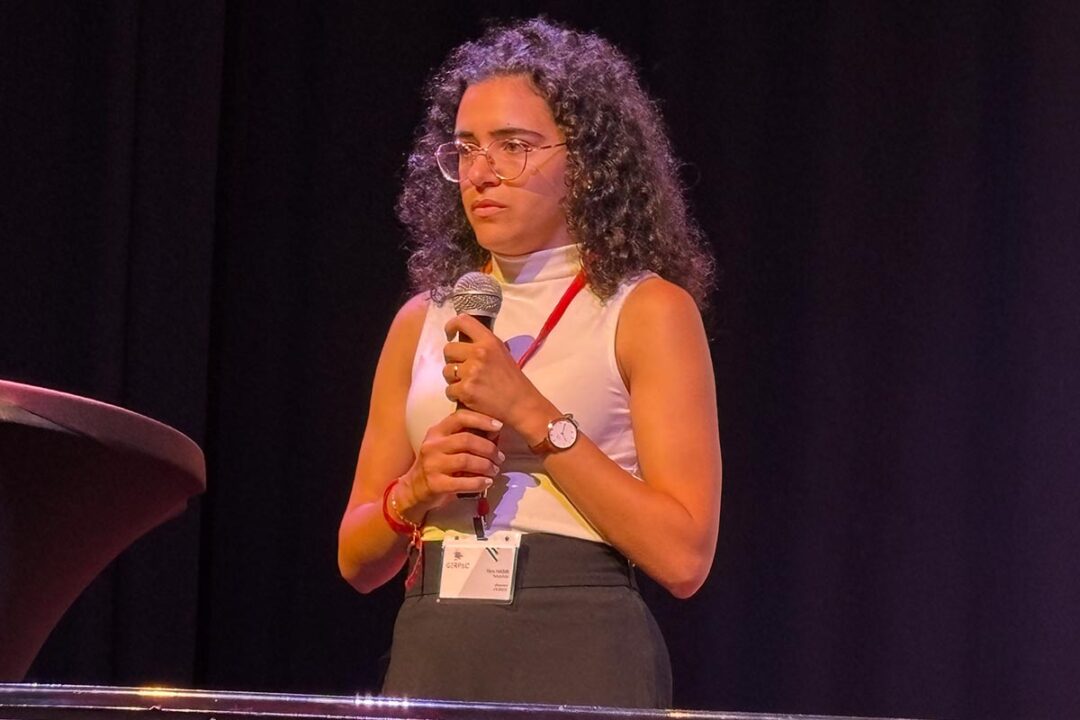
Image: Yara Habib