Low-cost system turns smartphones into emergency radiation detectors
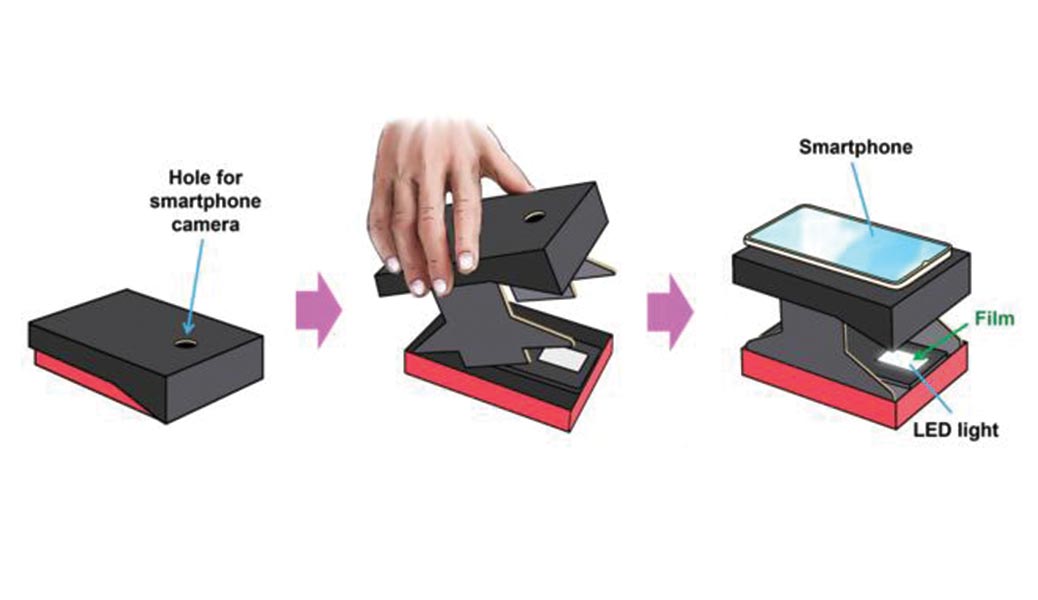
Prompt, individual-based dose assessment is essential to protect people from the negative consequences of radiation exposure after large-scale nuclear or radiological incidents. However, traditional dosimetry methods often require expensive equipment or complex laboratory analysis. Now, researchers at Hiroshima University have developed a cost-effective, portable dosimetry system that can provide immediate on-site readings using radiochromic film and a smartphone.
The study, published in Radiation Measurements, demonstrates a practical solution for personal preparedness in mass-casualty events. The system combines a small piece of Gafchromic EBT4 film with a foldable, battery-powered portable scanner and a smartphone camera.
“To protect people in the event of a severe radiological or nuclear accident, voluntary on-site dose assessments and prompt decisions regarding medical actions must be performed immediately,” says study corresponding author Hiroshi Yasuda, a professor at Hiroshima University’s Research Institute for Radiation Biology and Medicine. “Simplicity, universality, and cost-effectiveness are critical factors for these emergency measures.”
The EBT4 film is designed to change color instantly when exposed to radiation, a change that can be detected by the naked eye. By placing the film in a portable scanner and capturing an image with a smartphone, users can quantify relatively high radiation doses—up to 10 Gray—using mobile image-processing applications. To put this into perspective, a 10 Gray dose to the skin is high enough to cause permanent hair loss.
The research team tested the system using various smartphone models, including Samsung and iPhone devices. Their analysis showed that the cyan color channel in digital images provided the most consistent and reliable dose-response data. While professional desktop scanners offer higher precision, this smartphone-based approach provides an adequate solution that is highly portable and costs less than USD$70.
“Our goal was to design a system that works even under the worst-case accident scenarios, such as after a natural disaster where infrastructure might be damaged,” Yasuda adds. The team is now working to standardize the protocols and ensure the system remains reliable under diverse environmental conditions.
###
The study was co-authored by doctoral student Hassna Bantan and Professor Hiroshi Yasuda, both at Hiroshima University’s Research Institute for Radiation Biology and Medicine.
The open access publication costs for this paper were supported by Hiroshima University.
Image: Setup of the portable scanning system: a smartphone positioned above an LED-lit chamber for consistent film image capture.
View more Credit: Bantan et al., 2026, Radiation Measurements, CC BY-NC-ND 4.0