Piperacillin/tazobactam — elastomeric pumps in Paediatric Haematology and Oncology
EAHP Congress Highlights
Continuous piperacillin/tazobactam infusion via elastomeric pump offers a safe, cost-effective alternative to inpatient antibiotic therapy in paediatric oncology, with measurable benefits for ward capacity, healthcare costs and quality of life.
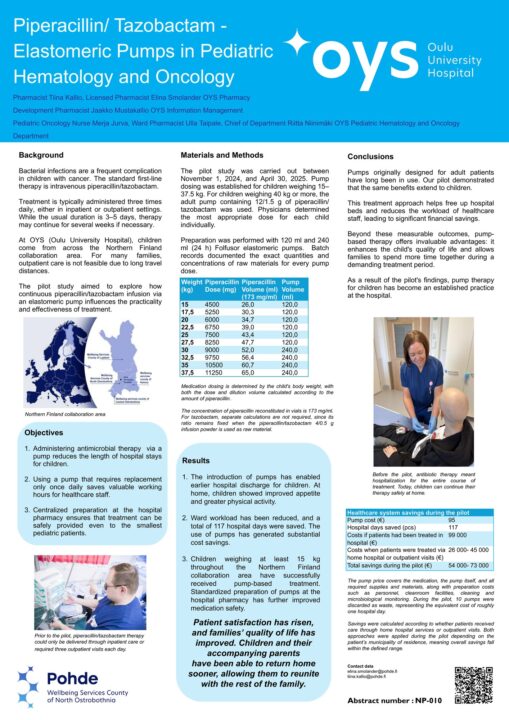
Bacterial infections are among the most common and serious complications in children with cancer, frequently requiring prolonged antibiotic therapy. Piperacillin/tazobactam (pip/taz) is the established first-line intravenous treatment, but its standard three-times-daily dosing schedule creates a significant logistical burden — particularly for families living far from tertiary care centres. A six-month pilot at Oulu University Hospital (OYS) explored whether continuous pip/taz infusion via elastomeric pump could safely shift this therapy out of the inpatient setting, with meaningful benefits for patients, families and the healthcare system.
Background and rationale
OYS serves children across the Northern Finland collaboration area, a large and sparsely populated region where many families cannot realistically attend three outpatient infusion visits per day. Prior to the pilot, pip/taz therapy therefore required full hospitalisation for the entire treatment course — often three to five days, but sometimes several weeks. Elastomeric pumps, well-established in adult oncology, offered an alternative: continuous 24-hour infusion requiring only once-daily pump replacement, enabling home-based treatment or a single daily outpatient visit.
Methods
The pilot ran from November 2024 to April 2025. Weight-based dosing was established for children weighing 15–37.5 kg, using 120 ml FOLfusor (Baxter) pumps for lighter patients and 240 ml pumps for those weighing 30 kg and above. Children weighing 40 kg or more received the standard adult pump containing 12/1.5 g of pip/taz. Piperacillin was reconstituted at 173 mg/ml; tazobactam calculations were unnecessary given the fixed 4:0.5 ratio of the infusion powder. All pumps were prepared centrally at the hospital pharmacy under cleanroom conditions, with full batch documentation for every dose.
Results
The pilot demonstrated clear clinical and operational benefits. First, children were discharged from hospital earlier; once home, families reported improved appetite and increased physical activity in their children. Second, ward workload fell substantially — 117 hospital days were saved over the six-month period. Each elastomeric pump was priced at €95, a figure that covers the medication, the device itself, all required supplies and materials, and pharmacy preparation costs including personnel, cleanroom facilities, and microbiological monitoring. Compared with the cost of inpatient care, this translated to total savings of €54,000–73,000 over the pilot period. Third, pump therapy was successfully delivered to children throughout the collaboration area, including the smallest eligible patients, with centralised pharmacy preparation supporting consistent medication safety.
Implications for practice
These results confirm that elastomeric pump-delivered pip/taz, long used in adults, can be extended effectively to the paediatric oncology population. The model reduces pressure on inpatient beds, lowers nursing workload and generates significant cost savings — while simultaneously improving quality of life for children and their families during an already demanding period of treatment. On the basis of the pilot’s findings, pump-based pip/taz therapy has been adopted as standard practice at OYS Paediatric Haematology and Oncology.
Healthcare professionals seeking further information may contact the OYS Pharmacy team at elina.smolander@pohde.fi or tiina.kallio@pohde.fi.